Geometry & Trigonometry
Area · Volume
CORD —
C Concept
O Operation · Desmos
R Recognition
D Drill
G1
Area & perimeter — square, rectangle, triangle, circle
Drill 41
Desmos
- Pure formula problems — Desmos is overkill. Just compute.
- For arithmetic: type the formula with numbers (e.g.
(1/2) * 8 * 5 for triangle area).
- Expand the row to read the value.
Concept
- Square: area $= s^2$, perimeter $= 4s$.
- Rectangle: area $= L \cdot W$, perimeter $= 2(L + W)$.
- Triangle: area $= \tfrac{1}{2} \cdot b \cdot h$.
- Circle: area $= \pi r^2$, circumference $= 2\pi r$.
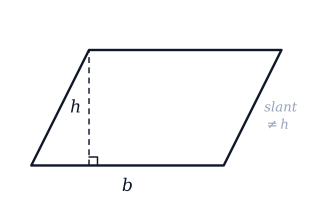
- Parallelogram: area $= b \cdot h$ (height ⊥ base, not slant).
- Trapezoid: area $= \tfrac{1}{2}(b_1 + b_2) \cdot h$.
Match the height to the base. Triangle / parallelogram height is the perpendicular distance, not a slant side.
RecognitionUses the slant side as the height for triangle or parallelogram area.
G2
Volume — prism, cylinder, cone, sphere
Drill 16
Desmos
- Type formula with numbers — Desmos returns the value.
- Use
pi for $\pi$ (Desmos prints exact form like 36 pi).
- e.g. cone with r=3, h=4:
(1/3) * pi * 3^2 * 4 → 12π.
Concept
- Prism / cylinder: $V = \text{base area} \cdot h$.
- Rectangular prism: $V = L \cdot W \cdot h$.
- Cylinder: $V = \pi r^2 h$.
- Cone: $V = \tfrac{1}{3} \pi r^2 h$.
- Sphere: $V = \tfrac{4}{3} \pi r^3$.
- Pyramid: $V = \tfrac{1}{3} \cdot \text{base area} \cdot h$.
Cone & pyramid have the $\tfrac{1}{3}$ factor. Cylinder & prism don't. Easy to forget.
RecognitionForgets the 1/3 factor on a cone or pyramid and picks the cylinder/prism volume.
Geometry & Trigonometry
Angles · Similar/Congruent
G3
Angles — parallel lines, transversal, triangle sum = 180
Drill 26
Desmos
- Pure geometric reasoning — Desmos has no shortcut.
- If algebra emerges (solve for $x$): type the equation.
Concept
- Triangle angle sum $= 180^\circ$. Quadrilateral $= 360^\circ$. $n$-gon $= 180(n-2)^\circ$.
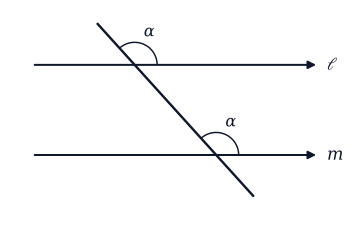
- Parallel + transversal: corresponding angles equal · alternate-interior equal · co-interior add to $180^\circ$.
- Vertical angles are equal. Linear pair adds to $180^\circ$.
- Exterior angle of a triangle $=$ sum of the two non-adjacent interior angles.
- Isosceles triangle: base angles equal. Equilateral: all $60^\circ$.
Co-interior (same-side interior) angles add to $180^\circ$ — NOT equal. Don't confuse with alternate-interior.
RecognitionSets same-side interior angles equal instead of summing to 180.
G4
Similar & congruent triangles
Drill 27
Desmos
- For ratio computation: set up the proportion as
a/b = c/x, type it in Desmos. Vertical line shows x.
- Or just cross-multiply mentally — usually faster.
Concept
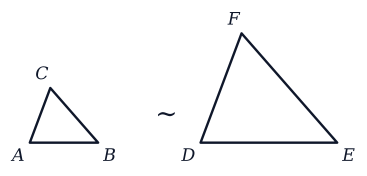
- Similar (AA): two pairs of equal angles → triangles are similar. Sides are proportional.
- Ratio of sides $= k$ → ratio of areas $= k^2$ · ratio of volumes $= k^3$.
- Congruent (same shape AND size): SSS, SAS, ASA, AAS, RHS (right-angle-hypotenuse-side).
- Set up correspondence first. If $\triangle ABC \sim \triangle DEF$, then $\dfrac{AB}{DE} = \dfrac{BC}{EF} = \dfrac{CA}{FD}$.
- Shadow / height problems use similar right triangles: $\dfrac{\text{height}_1}{\text{shadow}_1} = \dfrac{\text{height}_2}{\text{shadow}_2}$.
Areas scale by $k^2$, not $k$. If side ratio is $1:2$, area ratio is $1:4$, not $1:2$.
RecognitionScales area by k instead of k-squared when sides are in ratio 1:2.
Geometry & Trigonometry
Right triangle · SOHCAHTOA
G5
Right triangle — Pythagorean + special triangles
Drill 26
Desmos
- For Pythagorean: type
sqrt(a^2 + b^2) to get the hypotenuse value.
- Expand the row to read the value.
Concept
- Pythagorean: $a^2 + b^2 = c^2$ where $c$ is the hypotenuse.
- Common triples: 3-4-5, 5-12-13, 8-15-17, 7-24-25 (and any multiples).
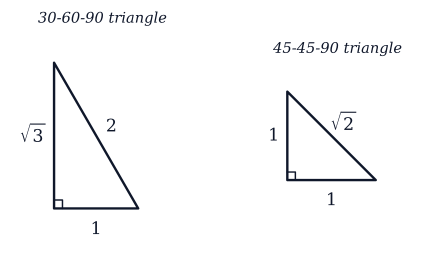
- 30-60-90: sides in ratio $1 : \sqrt{3} : 2$ (opposite 30°, 60°, 90°).
- 45-45-90: sides in ratio $1 : 1 : \sqrt{2}$.
- Hypotenuse is always opposite the right angle and is the longest side.
$\sqrt{2} \approx 1.414$, $\sqrt{3} \approx 1.732$. Memorize so you recognize them in decimal-form answers.
RecognitionMisses a 30-60-90 or 45-45-90 ratio hidden in a decimal like 1.732 or 1.414.
G6
SOHCAHTOA — sin / cos / tan ratios
Drill 21
Desmos
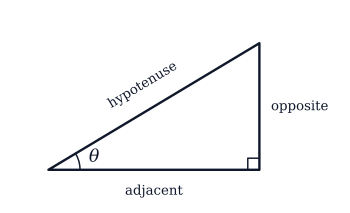
- For a known angle, Desmos computes the ratio (see G7).
- For "find sin θ given a triangle figure": identify opposite / adjacent / hypotenuse, then compute by hand — Desmos can't read the figure.
Concept
- SOH: $\sin\theta = \tfrac{\text{opposite}}{\text{hypotenuse}}$
- CAH: $\cos\theta = \tfrac{\text{adjacent}}{\text{hypotenuse}}$
- TOA: $\tan\theta = \tfrac{\text{opposite}}{\text{adjacent}} = \tfrac{\sin\theta}{\cos\theta}$
- Cofunction identity: $\sin\theta = \cos(90^\circ - \theta)$. (e.g. $\sin 30^\circ = \cos 60^\circ$.)
- Pythagorean identity: $\sin^2\theta + \cos^2\theta = 1$.
"Opposite / adjacent" depends on which angle you're at. A leg can be opposite for one angle and adjacent for the other.
RecognitionMixes up which leg is opposite vs adjacent after the reference angle changes.
Geometry & Trigonometry
Trig in Desmos · Circle basics
G7
Trig in Desmos — set mode, evaluate exact values
Drill 24
Desmos
- Click the wrench icon (top right) → choose Radians or Degrees.
- Use Radians when the angle has $\pi$ (e.g. $\pi/3$, $5\pi/2$).
- Use Degrees for plain numbers like $30, 45, 60, 90$.
- Type
sin(30), cos(45), tan(60) — Desmos returns the exact value.
- Convert: degrees $\times (\pi/180)$ = radians; radians $\times (180/\pi)$ = degrees.
Lesson · Trig in Desmos →
Concept
- Unit circle values:
$\sin 0 = 0$, $\sin 30 = \tfrac{1}{2}$, $\sin 45 = \tfrac{\sqrt{2}}{2}$, $\sin 60 = \tfrac{\sqrt{3}}{2}$, $\sin 90 = 1$.
$\cos$ is the reverse: $\cos 0 = 1$ down to $\cos 90 = 0$.
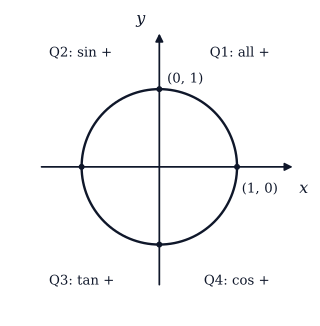
- Quadrants ("All Students Take Calculus"):
Q1: all positive · Q2: sin+ · Q3: tan+ · Q4: cos+.
- Big angle reduction: add/subtract multiples of $360^\circ$ (or $2\pi$) to get into one cycle.
RecognitionPicks the answer that used the wrong mode (radians instead of degrees, or vice versa).
G8
Circle basics — circumference, area, sector, arc
Drill 6
Desmos
- Compute with numbers:
pi * 5^2 for area of radius-5 circle.
- Expand the row — Desmos prints exact form like
25 pi.
Concept
- Circumference: $C = 2\pi r = \pi d$.
- Area: $A = \pi r^2$.
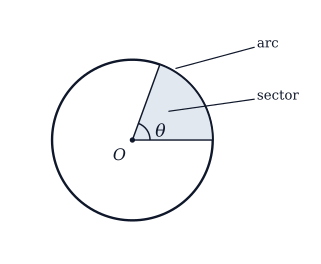
- Sector area (slice of pie): $\dfrac{\theta}{360} \cdot \pi r^2$ (degrees) or $\tfrac{1}{2} r^2 \theta$ (radians).
- Arc length: $\dfrac{\theta}{360} \cdot 2\pi r$ (degrees) or $r\theta$ (radians).
RecognitionForgets the θ/360 factor on a sector area or arc length when the angle is in degrees.
Geometry & Trigonometry
Circle equation · Inscribed / Tangent
G9
Circle equation $(x-h)^2 + (y-k)^2 = r^2$ — Desmos graph
Drill 26
Desmos
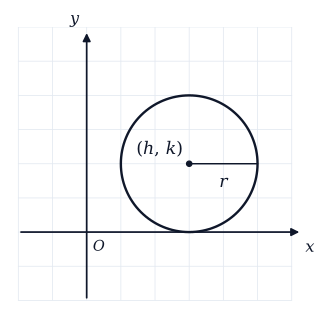
- Type the equation as-is, even in expanded form:
(x-3)^2 + (y-1)^2 = 25 or x^2 + y^2 - 6x - 2y - 15 = 0.
- Desmos draws the circle.
- Click the circle — Desmos marks center, x-intercepts, y-intercepts, and other points on the circumference.
- For "convert to standard form" problems: comparing what Desmos shows to answer choices is fastest.
Concept
- Standard form: $(x - h)^2 + (y - k)^2 = r^2$ → center $(h, k)$, radius $r$.
- General form: $x^2 + y^2 + Dx + Ey + F = 0$. Complete the square to convert.
- Completing the square: for $x^2 + Dx$, add $(D/2)^2$. Same for $y$.
- Diameter $= 2r$. Connects two points through the center.
RecognitionReads center signs backward or treats r² as the radius.
G10
Inscribed / central angles + tangent line
Drill 8
Desmos
- Pure geometric reasoning — Desmos doesn't compute these.
- If a coordinate version: plot the circle + line in Desmos, verify tangency visually.
Concept
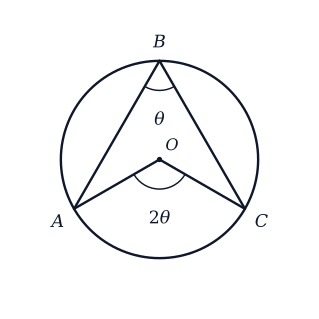
- Inscribed angle $=$ half the central angle that intercepts the same arc.
- Inscribed angle in a semicircle $= 90^\circ$ (Thales).
- Two inscribed angles intercepting the same arc are equal.
- Tangent line is perpendicular to the radius at the point of tangency.
- Two tangents from same external point have equal length.
Inscribed = half central. If central is $80^\circ$, inscribed (same arc) is $40^\circ$.
RecognitionSets the inscribed angle equal to the central angle instead of half of it.
 sat.ivypath.ioPage 1 of 5